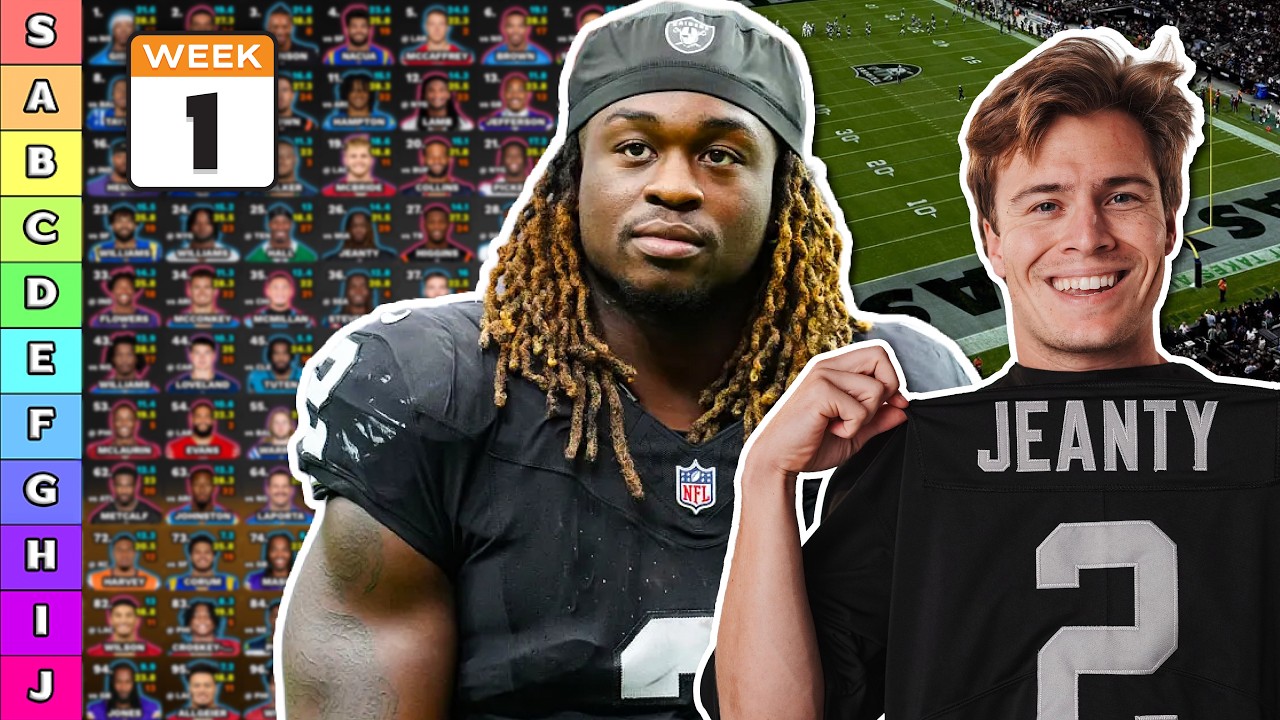
7 Running Backs I'd Bet Everything On
STACKED extracted the fantasy-relevant player signal from this video and kept the full transcript here for context.
Player insights
Chase Brown
Chase Brown finished the second half of the season once Joe Burrow returned with 21.2 fantasy points per game, ranking as the RB3, and the analyst projects him to be a round one caliber running back.
Insight pageChase Brown is being undervalued in fantasy drafts similar to how Aaron Jones was historically underrated despite consistent top-five finishes; the analyst has him ranked over Derrick Henry and Kenneth Walker.
Insight pageChase Brown has had back-to-back seasons as a bellcow, playing 16+ games in consecutive seasons, establishing him as a workhorse running back.
Insight pageThe analyst's most drafted running back with an average pick of 17.8 (middle of the second round), reflecting his preference to start with a wide receiver in round one and then target Chase Brown in round two.
Insight pageD'Andre Swift
Swift is being drafted as RB23 at his historical low, having never finished lower than RB24 in his NFL career, making him a safe value pick.
Insight pageThe Chicago Bears project to be the 10th best offense in the NFL with no added backfield competition, supporting Swift's value.
Insight pageSwift is the clear receiving back in Chicago's backfield over Kyle Munungwe, with at least three targets per game in every year of his NFL career, making him a very safe investment.
Insight pageSwift is the better receiving back in the Chicago Bears backfield and has had at least three targets per game in every year of his NFL career, making him a very safe investment.
Insight pageDe'Von Achane
Despite the Dolphins offense projecting to be worse this season, Achane is being priced as RB8 in the top of the second round while averaging 18.5 PPG over his career—nearly identical to Bejian Robinson (18.8) and Jir Gibbs (19.8), who go in the first round.
Insight pageThe Dolphins offense projects to be worse this season (18.9 PPG vs. 20.5 PPG last year), and author expects Achane's receiving yards (averaging 29 per game) will likely decline due to worse quarterback play with Malik Willis.
Insight pageAchane is being drafted as RB8 in the second round but can return value despite Miami's worse offense and Malik Willis's limited checkdowns, as he's the only weapon and can still produce based on volume even if his receiving yards decline.
Insight pageDespite offensive decline, Achane is priced in a range where he can underperform relative to last season and still return value as a second-round pick based on his volume and status as the team's only weapon.
Insight pageAchane is being drafted behind Saquon Barkley despite being younger (24 vs 29) and stepping into his prime, making him a better value in round two.
Insight pageKyren Williams
Kyren Williams' snap share dropped from 88% in 2024 to 70% this past season, with Blake Corum expanding his role in Los Angeles.
Insight pageDespite snap share concerns, Kyren Williams is being drafted in the fourth round (pick 36.9 average) while other backs with similar snap shares go much earlier, representing significant value.
Insight pageKyren Williams is the starter in the Rams offense, which projects to be the number one scoring offense in the league this season (30.5 PPG projected).
Insight pageHistorical comparisons (Frank Gore, James Cook, Joe Mixon, Mark Ingram, Marshon Lynch, Latavius Murray, Lamar Miller, Chuba Hubbard, Javante Williams) show that running backs with similar age-25 seasons to Kyren's typically improve the following year, with only Chuba Hubbard falling off.
Insight pageThe analyst is buying the dip on Kyren Williams, trusting the historical data over early-May concerns about his usage.
Insight pageRJ Harvey
Harvey broke out in the second half of his rookie season, jumping from 7.9 to 15.1 fantasy points per game and finishing as RB14, and is now being drafted as RB31 despite this improvement.
Insight pageHarvey's rookie season comps include DeAndre Swift, Rashad White, and James Cook—five of whom nearly doubled their points per game year-over-year, suggesting significant upside if Harvey reaches 13+ PPG.
Insight pageThe Denver Broncos project to be a below-average offense this year, scoring fewer points than last season (22.5 vs 23.5 PPG), which is a concern for Harvey's upside.
Insight pageTony Pollard
Tony Pollard was horrible last year, consistently seeing 20+ opportunities but scoring only nine fantasy points per game.
Insight pageThe Titans are projected to improve from 16.7 PPG in 2025 to 20.34 PPG in 2026 (a 3.5 point jump), one of the largest offensive improvements projected, which should benefit Pollard's fantasy output.
Insight pagePollard has a three-down workload and looked better at the end of the season than early in the year, with limited competition from a day-three rookie pick who broke his foot in the offseason.
Insight pagePollard's ADP has risen from author's average draft cost of pick 83.5 to a current ADP of 77.5, making him slightly tougher to acquire at the original price point.
Insight pageTreVeyon Henderson
Henderson has an ADP of 48.8 and the author has drafted him in 13 of 100+ drafts at an average cost of 48.12, viewing him as undervalued relative to his upside.
Insight pageHenderson showed significant improvement from his first to second half of his rookie season, jumping from 6.6 PPG to 17.1 PPG, and had three games with 20+ fantasy points in his rookie year.
Insight pageHenderson was the running back the Patriots trusted in the NFL playoffs, but he may still be a committee back with Madre Stevenson, and the author expresses regret about drafting him given the team's offensive regression.
Insight pageThe New England Patriots project to regress significantly this season with an implied team total of 22.9 PPG (down from 28.8 last year), the worst regression in the NFL, which makes Henderson's cost harder to justify if he remains a committee back.
Insight pageEpisode Transcript
More episodes from Flock Fantasy