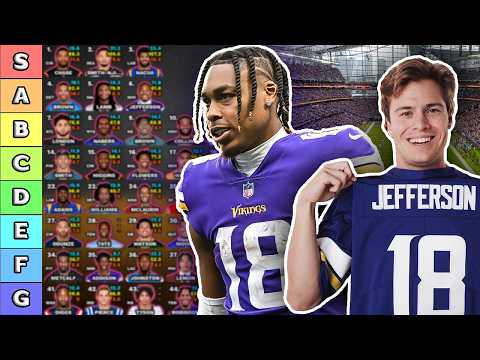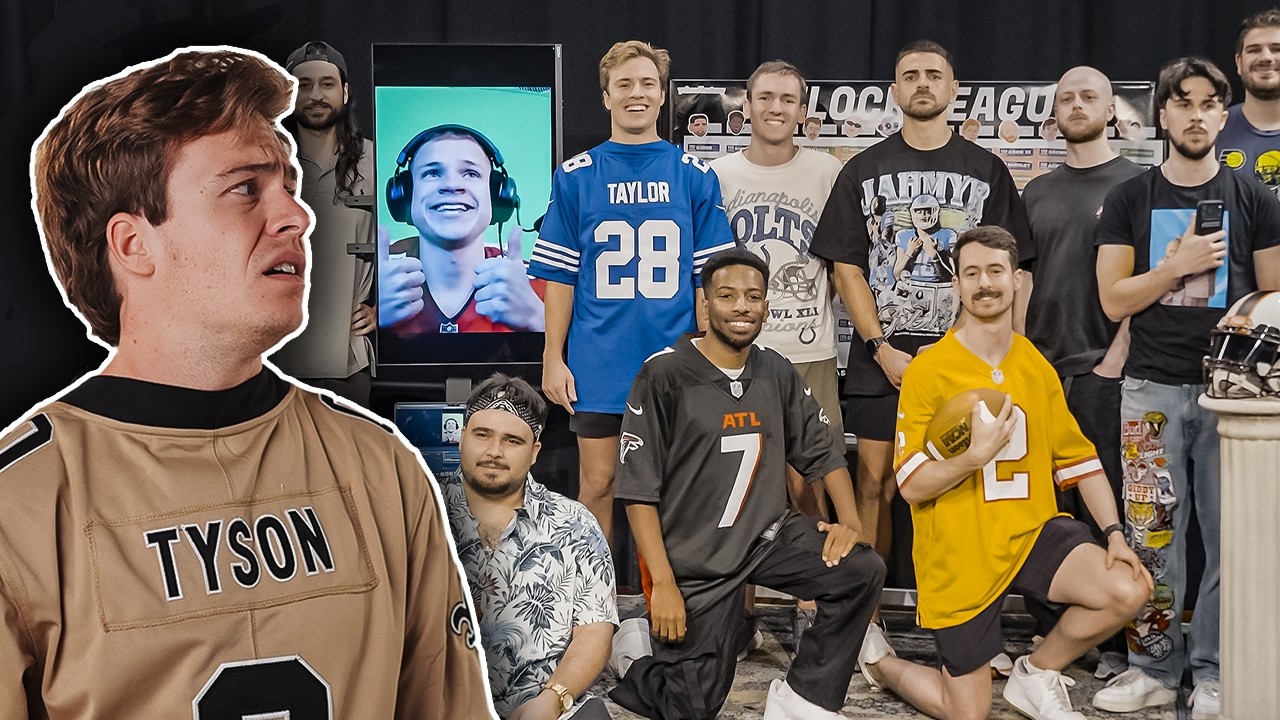
Flock League Tier List & Rankings
STACKED extracted the fantasy-relevant player signal from this video and kept the full transcript here for context.
Player insights
A.J. Brown
Selected second overall by the Flock developers' team in their draft.
Insight pageAlec Pierce
Available at pick 7.12 but passed over when Jordan Mason was reached ahead of him, representing better value at that draft position. Subsequently suffered an ankle injury, which is part of depth concerns at receiver.
Insight pageAlvin Kamara
Alvin Kamara suffered an injury that elevated Travis Etienne's role and value in Colston Loveland's Flock League team, making Etienne a third-round caliber asset.
Insight pageAshton Jeanty
Ashton Jeanty suffered an ankle injury that sidelined him for the season, forcing his team (Sammy Stacks and Danny Lat) into a desperate trade position. The team panicked and traded Justin Jefferson to Colston Loveland for Kenneth Walker and extra FAB dollars without waiting for official confirmation of Jeanty's season-ending status, which compounded their roster damage.
Insight pageBijan Robinson
Colston Loveland praised Rome's first-round selection of Bijan Robinson as a no-brainer pick, highlighting Rome's best-player-available strategy.
Insight pageBlake Corum
Colston Loveland highlighted Blake Corum as one of the strong running back values Zufus acquired late in the draft; noted that any one of Blake Corum, Rico Dowdle, or Keaton Mitchell hitting would make Zufus's team pretty damn good.
Insight pageBo Nix
Colston Loveland noted the drafter got Bo Nix in the thirteenth round, demonstrating good quarterback value and balance across the roster.
Insight pageBraelon Allen
Braelon Allen was selected in the super late rounds as part of a running back-heavy strategy to provide insurance in case of injury before the season starts.
Insight pageBreece Hall
Breece Hall was selected at the two-three turn (25 overall), but despite being an absolute stud, Colston Loveland criticized the pick as not difference-making. Loveland noted Hall produced similarly to running backs going in rounds three and four due to the garbage Jets offense; he would have preferred an elite tight end like McBride or elite receivers like George Pickens or Rashee Rice to set up better round four-five options.
Insight pageBrevin Jordan
Colston Loveland criticized Zufus's choice of Brevin Jordan Patterson as a running back selection, calling it a pretty bad call compared to alternatives like Quinton Jefferson and Judkins, with Ramondre appearing to be the starter for the New England Patriots.
Insight pageBrian Thomas Jr.
Brian Thomas is dealing with a shoulder injury, which compounds the editors' team's depth concerns at receiver, particularly if Josh Jacobs faces suspension; the team also has Alec Pierce dealing with an ankle injury, creating a precarious situation at the position.
Insight pageBrock Bowers
Brock Bowers was taken in the first three rounds by Zoof and Colston Loveland loved Zoof's team through the first three rounds, which included Ja'Marr Chase, Bowers, and Rashee Rice; Loveland highlighted Bowers as part of a strong best-player-available approach.
Insight pageBucky Irving
Bucky Irving is mentioned as an alternative running back option that would have been better value than Colston Loveland in the third round, suggesting Irving represented a more optimal draft strategy for addressing positional need. Colston Loveland also approved of Irving as Zach's round 4 pick, though he would have preferred a receiver at that spot like Ebuka Obi Melifonwu or Tetairoa McMillan.
Insight pageCarnell Tate
Cornell Tate is the wide receiver two on Sammy Stacks and Danny Lat's roster after their draft and trades, serving as their secondary receiving option on a weakened team.
Insight pageChase Brown
Chase Brown was selected by Nathan in the first two rounds as a starting running back anchor; paired with Devon Achane, this early RB commitment was a smart move that positioned the drafter to take advantage of strong wide receiver values that fell through the middle rounds.
Insight pageChris Olave
Colston Loveland traded Chris Olave to Rome, describing him as an absolute smash after Jordan Addison was ruled out for two months, elevating Olave's value. However, Loveland drafted Olave as best available but was not a massive fan of him at his cost this year, trading him away along with Kenneth Walker and the Rams defense to acquire Justin Jefferson and Travis Etienne.
Insight pageChristian McCaffrey
The Flock developers' team built their entire draft around McCaffrey as their first pick; the speaker notes they put themselves at massive risk from the very jump because if McCaffrey gets injured, they would have the worst running back room in the league by a wide margin.
Insight pageChristian Watson
Available at pick 6.01 but passed over when Jaylen Warren was reached ahead of him, representing better value at that draft position. Colston Loveland was very ecstatic to acquire Christian Watson in round 6, indicating strong enthusiasm for the pick in that range. Loveland has Watson in a flex spot, providing depth and upside at the position.
Insight pageColston Loveland
Drafted in the third round (pick 36) by Sammy Stacks and Danny Lat, described as a reach for an 'elite tight end' that violated draft value principles. This early tight end selection cascaded into worse mistakes down the board, forcing the team to reach on running backs like Jaylen Warren at 6.01 ahead of DJ Moore and Christian Watson, and Jordan Mason at 7.12 ahead of Alec Pierce and Jordan Addison. The Loveland pick weakened the team's running back and wide receiver depth from the start, compounding their roster construction problems.
Insight pageD.J. Moore
Available at pick 6.01 but passed over when Jaylen Warren was reached ahead of him, representing better value at that draft position. Later fell to Zach in round 6 where Colston Loveland described it as 'incredible value,' highlighting Moore as one of several quality receivers who fell to strong value prices.
Insight pageD'Andre Swift
Colston Loveland preferred D'Andre Swift over the running back selections made (D'Onta Foreman and David Montgomery), indicating Swift was the better value choice at that draft stage. Loveland criticized the combination of Foreman and Montgomery as having a capped ceiling, making Swift a superior alternative.
Insight pageDeAndre Swift in the fourth round looked damn good after the Kyle Pitts injury; the pick was taken before the injury occurred but worked out well in hindsight.
Insight pageD'Onta Foreman
Colston Loveland criticized the selection of D'Onta Foreman in combination with David Montgomery in the running back rounds, arguing the pairing has a capped ceiling and was the wrong choice at running back compared to available alternatives like D'Andre Swift and Travis Etienne.
Insight pageDallas Goedert
Dallas Goedert was selected in the 12th round and was considered a great pick in the draft by Colston Loveland.
Insight pageDavante Adams
Davante Adams was drafted by Avery in the fifth round of Colston Loveland's Flock League; Loveland credits Adams as one of several good values Avery sniped in the draft, contributing to Avery's strong team construction.
Insight pageDavid Montgomery
Colston Loveland criticized the selection of David Montgomery in combination with D'Onta Foreman in the running back rounds, arguing the pairing has a capped ceiling and was the wrong choice at running back compared to available alternatives like D'Andre Swift and Travis Etienne.
Insight pageDe'Von Achane
Devon Achane was selected by Nathan in the first two rounds as a starting running back anchor; paired with Chase Brown, this early RB commitment was a smart move that positioned the drafter to take advantage of strong wide receiver values that fell through the middle rounds.
Insight pageDerrick Henry
Derrick Henry is Avery's anchor running back; Colston Loveland assesses that if Henry holds the anchor RB slot, Avery's team has a legitimate chance to win the league again, despite Avery's running back position being described as "maybe a little bit weak."
Insight pageDrake London
Drake London was selected in the first two rounds alongside Jaxon Smith-Njigba, providing a strong wide receiver floor where almost no matter what happens outside of injury, the drafter will be set at the position. Colston Loveland praised this pairing as giving the team a very nice range at wide receiver.
Insight pageDrake Maye
Colston Loveland drafted Drake May as his first quarterback, committing to the position early; he avoided taking a second quarterback, reading the room that other drafters like Sal Vetri would do the same. Later in the draft, Loveland noted he has a good quarterback room with Drake May, providing depth at the position.
Insight pageGarrett Wilson
Garrett Wilson selected at the end of the fourth round was characterized by Colston Loveland as 'a great pick' because it was the last wide receiver taken in that round; Loveland noted the drafter's prior-year mistake of drafting Wilson over Justin Jefferson in round one, but viewed the fourth-round acquisition as strong value relative to the tier.
Insight pageGeorge Pickens
George Pickens was viewed as an elite receiver option that should have been prioritized over Javonte Williams; in full PPR format, Pickens in the first flex spot would have been 'so damn good.' Colston Loveland was close to drafting Pickens in round three but got sniped twice during the draft, indicating he viewed Pickens as undervalued at his ADP. Pickens was ultimately drafted by Avery in round three and represents strong value that contributed to Avery's second-best team in the Flock League.
Insight pageIsiah Pacheco
Isaiah Pacheco got injured, representing a middle-round pick that busted to the downside for the editors' team, leaving them without depth to recover from the injury.
Insight pageJa'Marr Chase
Ja'Marr Chase was taken in the first round by Zoof and Colston Loveland loved Zoof's team through the first three rounds, which included Chase, Brock Bowers, and Rashee Rice; Loveland praised the best-player-available strategy through rounds 1-3 despite deferring running back.
Insight pageJadarian Price
Rookie running back selected in the fifth round by the Flock developers' team; part of a draft strategy that left them with a weak running back room overall.
Insight pageJahmyr Gibbs
Jahmyr Gibbs would have been a better fifth-round selection than Lamar Jackson as part of a draft strategy prioritizing positional depth and best-player-available approach. Colston Loveland suggested that taking Gibbs in round five instead of a quarterback would have improved overall draft construction.
Insight pageJames Cook
James Cook was Zach's round-one pick; Colston Loveland praises it as a "really, really smart call" for Zach to grab a running back early, given the wide receiver value available later in the draft.
Insight pageJameson Williams
Colston Loveland has Jameson Williams in a flex spot on his Flock League team, providing depth and upside at the position.
Insight pageJavonte Williams
Javonte Williams was selected in a draft, but Colston Loveland expressed a hold-up with the pick, suggesting the drafter should have gone with a best-player-available approach instead, potentially selecting George Pickens in that spot and then Jahmyr Gibbs in the fifth round instead of Lamar Jackson.
Insight pageJaxon Smith-Njigba
Jaxon Smith-Njigba was selected in the first two rounds alongside Drake London, giving the drafter a very nice wide receiver floor where almost no matter what happens outside of injury, he will be set at the position.
Insight pageJayden Higgins
Colston Loveland's 11th-round pick Jayden Higgins was lost for the year approximately 5 days after the draft, creating a significant depth loss for Loveland's team.
Insight pageJaydon Blue
Colston Loveland noted that the drafter dropped Jayden Blue post-draft, contributing to a roster construction with eight wide receivers and only three running backs.
Insight pageJaylen Waddle
Jaylen Waddle is the wide receiver one on Sammy Stacks and Danny Lat's roster after their draft and trades, serving as their primary receiving option on a weakened team. Waddle is part of a tier of similarly-valued receivers in the third round alongside Tee Higgins, Emeka Egbuka, Marvin Mims, Garrett Wilson, and Ladd McConkey; all are about the same value and any selection in this range will seem slightly early.
Insight pageJaylen Warren
Reached on at pick 6.01 by Sammy Stacks and Danny Lat, taken ahead of more talented players like DJ Moore and Christian Watson. This reach was a cascading consequence of the team's earlier third-round tight end selection (Colston Loveland), forcing them to overdraft at running back to address positional need.
Insight pageJeremiyah Love
Jeremiah Love was taken in the second round as a homer pick for the Arizona Cardinals but subsequently suffered a high ankle sprain, making the pick regrettable in hindsight.
Insight pageJonathan Taylor
Colston Loveland identifies Jonathan Taylor as a critical injury risk to his team's championship viability; Taylor is one of two first-round anchors alongside Justin Jefferson, and Loveland explicitly states that an injury to Taylor or Travis Etienne would cause his team to fall apart quickly despite holding the most FAB dollars ($1,200) in the league.
Insight pageJordan Addison
Available at pick 7.12 but passed over when Jordan Mason was reached ahead of him, representing better value at that draft position. Later fell to Zach in round 8 where Colston Loveland described it as 'incredible value.' Subsequently ruled out for two months after Loveland traded Chris Olave to Rome, and Loveland's team suffered an additional injury keeping Addison out for a couple months, creating a significant gap in Loveland's receiving corps; however, Loveland has late-season upside if Addison returns halfway through the year to help cover bye weeks.
Insight pageJordan James
Colston Loveland noted that the drafter dropped Jordan James post-draft, contributing to a roster construction with eight wide receivers and only three running backs.
Insight pageJordan Mason
Reached on at pick 7.12 by Sammy Stacks and Danny Lat, taken ahead of more talented receivers like Alec Pierce and Jordan Addison. This reach was another cascading consequence of the team's poor draft construction stemming from the third-round tight end selection, forcing them to overdraft at running back.
Insight pageJosh Downs
Josh Downs was selected in round seven and was criticized as 'horrendous' by Colston Loveland, who noted there were at least 10 other players on the board he would have preferred. Loveland expressed personal bias against Downs as a player, indicating he is not a fan of the receiver.
Insight pageJosh Jacobs
Josh Jacobs carries suspension risk that is particularly problematic for the editors' team; if he gets suspended, their depth becomes incredibly questionable given Brian Thomas is dealing with a shoulder injury and Alec Pierce has an ankle injury. Jacobs was also mentioned as an alternative running back option that would have been better value than Colston Loveland in the third round.
Insight pageJustin Herbert
Colston Loveland praised the drafter for securing Justin Herbert in the tenth round, demonstrating good quarterback value and balance across the roster.
Insight pageJustin Jefferson
Justin Jefferson was traded away by Sammy Stacks and Danny Lat to Colston Loveland in a panic move after Ashton Jeanty's ankle injury, in exchange for Kenneth Walker and extra FAB dollars. The team made this trade without waiting for official confirmation of Jeanty's season-ending status, which further weakened their roster by losing their top wide receiver. However, Loveland later acquired Jefferson back as a round-one selection in a separate trade, sending Kenneth Walker, Chris Olave, and the Rams defense to get him and Travis Etienne.
Insight pageKeaton Mitchell
Colston Loveland highlighted Keaton Mitchell as one of the strong running back values Zufus acquired late in the draft; noted that any one of Keaton Mitchell, Blake Corum, or Rico Dowdle hitting would make Zufus's team pretty damn good.
Insight pageKeenan Allen
Keenan Allen is listed in the depth chart for Sammy Stacks and Danny Lat's roster, serving as depth at wide receiver on a weakened team that experienced an unlucky injury situation.
Insight pageKenneth Walker III
Kenneth Walker was acquired by Sammy Stacks and Danny Lat in a trade for Justin Jefferson as a panic move before official confirmation of Ashton Jeanty's season-ending status. Colston Loveland later drafted Kenneth Walker as best available in round three but was not a massive fan of him at his cost this year, leading Loveland to trade him away along with Chris Olave and the Rams defense to acquire Justin Jefferson and Travis Etienne.
Insight pageKenyan Drake
Colston Loveland likes Kenyon Drake in best ball for late-season upside, but the Flock developers' team is rostering him on their bench over higher-upside handcuff running backs or wide receivers that could fill flex spots, representing a roster construction inefficiency.
Insight pageLamar Jackson
If Lamar Jackson returns to his 2024 form, he scores 30 points per game in this scoring format and could break fantasy football entirely; however, there is significant risk if he regresses, as he would become no better than a waiver-wire quarterback in a six-point passing touchdown league. Per Colston Loveland, the upside is extreme but the downside is substantial.
Insight pageMakai Lemon
Makai Lemon was taken in the seventh round and Colston Loveland really liked this pick, indicating strong value at that draft position.
Insight pageMalik Nabers
Malik Nabers was selected at the two-three turn alongside Breece Hall, but Colston Loveland questioned this draft strategy. Loveland criticized the pairing as poor value, noting that despite Nabers being a talented prospect, the drafter could have optimized by going with elite receivers like George Pickens or Rashee Rice in round three instead, which would have set up better round four-five options.
Insight pageMatthew Golden
Matthew Golden is a high-upside wide receiver target in the ninth-round range; should be prioritized over kickers in that draft range.
Insight pageMichael Pittman
Colston Loveland called Michael Pittman Jr.'s sixth-round selection a bad pick, though he acknowledged there weren't many other exciting players available at that point in the draft.
Insight pageMike Evans
Mike Evans was selected in round five alongside Terry McLaurin, and Colston Loveland criticized him as an aging wide receiver with injury concerns. Loveland would have preferred Travis Etienne in round five instead, noting the drafter could have optimized by going George Pickens in round three and Etienne in round five rather than Breece Hall and Mike Evans.
Insight pageNajee Harris
Najee Harris signing with the New York Giants is mentioned as context for why Cam Skelton's fourth-round pick looks worse in retrospect; the signing affected the Giants' backfield composition.
Insight pageNico Collins
Nico Collins was selected in round two and Colston Loveland praised it as one of the best picks on the board, highlighting Corey Bushlin's best player available approach that paid off.
Insight pageOmar Cooper Jr.
Omar Cooper was drafted as a round-one New York Jet with flex spot potential; Colston Loveland suggested he could be a better bench option than Kenyon Drake, indicating the drafting team viewed him as having upside relative to other available wide receivers at that stage.
Insight pagePuka Nacua
Puka Nacua was selected in round one and Colston Loveland praised it as one of the best picks on the board, highlighting Corey Bushlin's best player available approach that paid off.
Insight pageQuentin Johnston
Reached on in the sixth round by the Flock developers' team; the speaker explicitly calls this a reach that put the team at massive risk from the start.
Insight pageColston Loveland said Quintin Johnston in the fifth round makes a ton of sense as a draft pick.
Insight pageRashee Rice
Rashee Rice was taken in the first three rounds by Zoof and Colston Loveland loved Zoof's team through the first three rounds, which included Ja'Marr Chase, Brock Bowers, and Rice; Loveland also highlighted Rice as an elite receiver option that should have been prioritized in round three over Breece Hall, as it would have set up better round four-five picks and improved overall draft construction.
Insight pageRico Dowdle
Colston Loveland identified Rico Dowdle as one of the strong running back values Zufus acquired late in the draft; noted that any one of Rico Dowdle, Blake Corum, or Keaton Mitchell hitting would make Zufus's team pretty damn good.
Insight pageRyan Flournoy
Listed in the depth chart for Sammy Stacks and Danny Lat's roster as depth at wide receiver on a weakened team.
Insight pageSaquon Barkley
Colston Loveland had Saquon Barkley targeted in round two as a value pick but was sniped by another drafter (Zach). Loveland wanted Barkley "so damn badly" in round two, indicating he viewed Barkley as undervalued at his round-two ADP.
Insight pageTank Bigsby
Tank Bigsby was selected in the super late rounds as part of a running back-heavy strategy to provide insurance in case of injury before the season starts.
Insight pageTerry McLaurin
Terry McLaurin was selected in round five alongside Mike Evans, and Colston Loveland criticized both as aging wide receivers with potential injury concerns. Loveland would have preferred Travis Etienne in round five instead, arguing the drafter could have optimized by going George Pickens in round three and Etienne in round five rather than Breece Hall in round three and McLaurin in round five.
Insight pageTravis Etienne
Colston Loveland identified Travis Etienne as a preferable running back target over D'Onta Foreman and David Montgomery, calling him the best value in the entire draft when taken in the fifth round. Loveland later acquired Etienne in a trade and now views him as a third-round player after Alvin Kamara's injury elevated Etienne's role and value; Loveland considers Etienne a key anchor for his running back room alongside Jonathan Taylor. However, Loveland identifies Etienne as a critical injury risk to his team's championship viability; if Etienne suffers an injury, the team's depth falls apart quickly despite Loveland holding the most FAB dollars ($1,200) in the league.
Insight pageTravis Hunter
Travis Hunter, a cornerback, is listed in the depth chart for Sammy Stacks and Danny Lat's roster at wide receiver, indicating the team's desperation and poor roster construction after their draft mistakes and trades.
Insight pageTucker Kraft
Tucker Kraft was taken in the eighth round and Colston Loveland views this as incredible value, highlighting strong draft capital efficiency at that position.
Insight pageWoody Marks
Woody Marks was selected in the super late rounds as part of a running back-heavy strategy to provide insurance in case of injury before the season starts.
Insight pageXavier Worthy
Xavier Worthy was drafted by Colston Loveland in the Flock League; Loveland's stated reason for the pick was team construction—needing at least one Texas Longhorn on his roster, prioritizing roster personality over pure value and passing on Casey Conception to make the selection.
Insight pageEpisode Transcript
More episodes from Flock Fantasy